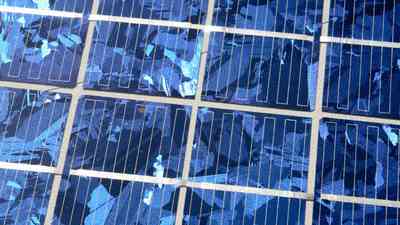
Solar cells are a primary component in the solar system to convert sunlight into electrical energy. Solar cells are the building blocks of solar panels, which can be used to generate electricity for homes, businesses, and other applications.
⚙️ How does it work?
When light strikes the solar cell, it leads to movement of electrons that is collected by metal contacts on the front and back of the cell. The flow of electrons through the contacts creates a flow of current that can be used to generate electricity.
The process of making a solar cell from sand to a functioning cell involves several steps:
- Raw Material Extraction: Sand is processed to extract silicon, the primary source of solar cells.
- Silicon Purification: The extracted silicon is purified to remove impurities and increase its quality. The purity of silicon in solar cells is critical to their performance, with higher purity levels resulting in more efficient solar cells. The most commonly used type of silicon in solar cells is crystalline silicon, which is typically between 99.999% and 99.9999% pure.
- Silicon Wafer Preparation: The purified silicon is melted and then cooled to form a single crystal ingot, which is then cut into thin wafers.
- Cell Texturing: The surface of the silicon wafer is treated to increase its light-absorbing capabilities and reduce reflections.
- P-Type Layer Deposition: A phosphorus-doped layer is deposited onto the textured surface to create a p-type semiconductor. In doping process, we intentionally add impurities in pure semiconductor to change or update electrical, optical and structural properties of that semiconductor.
- N-Type Layer Deposition: An n-type semiconductor layer is deposited onto the p-type layer, creating a p-n junction.
- Metal Contacts: Aluminum or other metal contacts are deposited on the front and back of the solar cell to allow for electrical connections.
- Encapsulation: The solar cell is sealed in a protective layer of glass or plastic to prevent damage and increase durability.
- Testing: The completed solar cell is tested to determine its efficiency, stability, and performance.
With developing technologies, we can find several types of solar PV cells in market but the most common are:
- Polycrystalline
- Monocrystalline
- Mono PERC
- Thin-film
- Bifacial
Types of solar cells
Let’s get some more information about different types of solar cells.
Polycrystalline
Polycrystalline solar cells are photovoltaic (PV) cells made from multiple crystal structures of silicon.
They are less efficient than monocrystalline solar cells, with lower energy conversion rates, but are also less expensive and have a shorter production process.
They are commonly used in residential and commercial solar panel systems and have a distinctive, speckled appearance due to the multiple crystal structures. Despite being less efficient, polycrystalline solar cells are still a reliable and cost-effective source of renewable energy.
Monocrystalline:
Monocrystalline solar cells are photovoltaic (PV) cells made from a single crystal structure of silicon.
They are the most efficient type of solar cells, with a higher energy conversion rate compared to polycrystalline and thin-film solar cells. They are also more expensive, have a longer lifespan, and have a sleek, uniform appearance due to the uniform crystal structure.
Monocrystalline solar cells are commonly used in large-scale solar power plants, but are also becoming more prevalent in residential and commercial solar panel systems.
PERC Technology
PERC stands for Passivated Emitter Rear Contact technology and is a type of solar cell design. It is an advanced solar cell technology that improves the efficiency of solar panels by adding an extra layer (passivation layer) to the rear side of the cell. This layer helps to reduce recombination of electrons, thereby increasing the cell's ability to convert sunlight into electricity. The result is a higher power output and a more efficient solar panel.
Mono PERC
Mono-PERC refers to Monocrystalline Passivated Emitter and Rear Cell. Mono-PERC is a technology used in monocrystalline solar cells that improves their energy conversion efficiency. It involves adding a reflective layer behind the cell and passivating (insulating) the rear side of the cell to reduce energy losses and increase the amount of light absorbed by the cell.
Mono-PERC cells have higher energy conversion efficiencies compared to traditional monocrystalline solar cells and are becoming increasingly popular in the solar industry. Mono-PERC are commonly used in large-scale solar power plants, but also in residential and commercial solar panel systems.
Bifacial Solar Cells
Bifacial solar cells are photovoltaic (PV) cells that can absorb light from both the front and back sides. This increases the amount of light absorbed and the overall energy conversion efficiency of the solar panel.
Bifacial solar cells are typically made of monocrystalline or polycrystalline silicon and are becoming increasingly popular in the solar industry due to their improved energy production capabilities.
They are typically mounted on transparent or semi-transparent surfaces that allow light to pass through to the back side of the cell, such as glass or clear plastic. Bifacial solar cells are commonly used in residential and commercial solar panel systems.
Thin film solar cells
Thin-film solar cells are photovoltaic (PV) cells made from thin layers of photovoltaic material, typically including silicon, cadmium telluride (CdTe), or copper indium gallium selenide (CIGS). They are less efficient than monocrystalline and polycrystalline solar cells, but have the advantage of being lightweight and flexible, making them suitable for use in a wide range of applications, such as on building facades, roofing, and portable electronic devices. Thin-film solar cells also have a lower environmental impact, as they require less raw material to produce compared to traditional solar cells.
Despite being less efficient, thin-film solar cells are a reliable and cost-effective source of renewable energy and are becoming increasingly popular in the solar industry
Conclusion
Solar cells are a key component in harnessing the power of the sun for clean and renewable energy. Solar cells come in various forms. These cells are then connected to form a solar panel, which can be used to generate electricity for a variety of applications, including small applications, powering homes and buildings, or for use in large-scale solar power plants.
Related guides
Continue learning with more guides from the Solar Library.
Solar Panels
Solar panels, comprised of photovoltaic cells, are transformative devices that convert sunlight into electricity, providing an eco-friendly and renewable energy solution. These panels play a pivotal role in generating power for a wide range of applications, from residential to commercial and industrial settings.
Read guide
Types of Solar Panels
Each type of solar panel has its unique characteristics, advantages, and disadvantages. Understanding the different types of solar panels can help you make an informed decision when choosing a solar panels for your system at home or business.
Read guide
Earth Geometry
Understanding Earth geometry is important for solar PV systems because the amount of solar energy that can be harvested by a PV system depends on the position of the sun relative to the PV panels. The angle and direction of the sun's rays change throughout the day and throughout the year as the Earth rotates and revolves around the sun, and this affects the amount of energy that can be captured by the PV panels.
Read guide