Basic Electrical Concepts
Explore essential principles of basic electrical engineering, focusing on voltage, current, power, and electric energy—critical elements for understanding and optimizing solar PV systems. As functionality of solar PV system totally depends on electrical parameters, it is important to know these basic electrical concepts for better understanding solar system and its working.
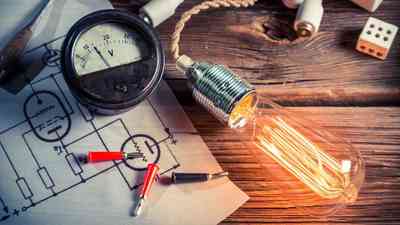
When we talk about electricity, we always talk about basic electrical parameters such as, voltage, current, and wattage(power). These electrical parameters define the rating and sizing of any electrical system or device.
💡 Why to understand?
As we are dealing with the generation of electricity using solar PV systems, we need to understand basic electrical parameters. Knowing these basic electrical parameters will help you to easily understand any concepts in the solar PV system. Here, understanding basics concepts are enough, no need of advanced understading of these topics.
To understand basic electrical concepts, we will use simple electrical circuits.
What is an electrical circuit? An electrical circuit is a closed path that forms with different electrical or electronic components. Electrons flow through such a circuit to produce electricity.
A bulb is connected to an energy source (Battery). A switch is connected between a bulb and a battery to connect and disconnect a circuit. In this circuit, the switch works same as a switch that we use in our home to switch on and off home appliances such as lights, fans, T.V., A.C., etc.
When a switch is ON, the bulb will glow. When a switch is OFF, the bulb will not glow.
Current
Current refers to the flow of electron in a circuit. When switch is ON, current flow through circuit and bulb glows. Larger the current means more electrons flow through circuit and smaller the current less electrons flow.
- Current is denoted by I.
- Current is measure in Ampere (A).
As we have seen, a current is the flow of electrons but current flows in two different ways. There are two types of electrical current AC (Alternating Current) and DC (Direct Current).
AC (Alternating Current)
AC current is a type of current in which the direction of the flow of electrons changes periodically. AC current flows in form of waveform called as "Sine Wave". The main advantage of AC is that it can be transmitted over long distances with less loss of energy than DC, which is why it is used for power transmission.
AC (Alternating Current) is used in:
- Household appliances (e.g., air conditioners, refrigerators, washing machines)
- Electric Power Transmission
- Industrial motors
- Lighting (e.g., fluorescent lights)
- Electric vehicles charging.
DC (Direct Current)
DC current is a type of current in which the direction of the flow of electrons is constant. It doesn’t change periodically.
It is commonly used in batteries and electronic devices such as laptops smartphones and smartwatches. The main advantage of DC is that it is easy to convert to other voltages (increase or decrease voltage as per our needs or applications) using a device called a DC-DC converter, which makes it useful for powering portable devices and for charging batteries.
DC (Direct Current) is used in:
- Electronic devices (e.g., laptops, smartphones, power banks, portable devices)
- Batteries
- Solar panels
- Electric vehicles (e.g., electric cars)
- Medical equipment (e.g., pacemakers)
Voltage
Voltage is also called as "E.M.F. (Electro Motive Force)". EMF is a force required for motion (flow) of elections. Voltage is responsible for the energy transfer in an electrical system and is a crucial component in many electrical and electronic devices. An increase in voltage results in an increase in the energy of the charged particles and a corresponding increase in the flow of current.
- Voltage is denoted by V.
- Voltage is measure in Volts (V).
Power
Power is the rate at which energy is transferred in the circuit. Power is a crucial factor in electrical systems as it determines the amount of energy that can be consumed (used) by any device in a given time. The power delivered to a device is equal to the energy it consumes over time, so the larger the power, the more energy is consumed in a shorter amount of time.
Understanding power is important for designing and evaluating electrical systems, as well as for understanding energy usage and cost.
- Power is the product of voltage and current.
- Power is denoted by P or W.
- Power is measured in Watts (W).
Power (W) = Voltage (V) x Current (A)
In solar PV system, we deal with large amount of power. We measure such a large power in kilo-watts or kW. Size of solar PV system measured in kW. Even we measure large size solar PV systems in mega-watts or MW and giga-watts or GW. Now a days many companies are dealing in only MW and GW projects for large size solar PV systems.
Electrical Energy
In general terms, energy is an ability or capacity to do work over a period of time. In electrical terms, electrical energy is utilization of a power over time. In simple words, how much power is utilized for particular time period.
- Energy is denoted by E.
- Electrical energy is measured in kilowatt-hours (kwh or units).
Unit is a term use by Energy Distribution Companies (DISCOMS) to measure energy consumption at your premises.
= Power (of bulb) x Time (hrs)
= 100 watts x 10hrs
= 1000 watt-hours or 1kwh or 1 unit.
Connections
We design or form an electrical circuit by connecting different electrical components. We connect such components in different configurations (ways). It is important to understand this concept because while designing a solar system we will connect all solar panels in series or parallel configuration as per our requirement to get desired output values.
Different types of connections
- Series connection
- In series connection, we connect electrical components end to end or in a line.
- In series connection, voltage adds but current remains same.
- Parallel connection
- In parallel connection, we connect end of electrical components together.
- In parallel connection, current adds but voltage remains same.
- Series-parallel connection
- In series parallel connection, we use combination of series and parallel configurations.
Conclusion
In this section, we have seen basic but most imporant electrical concepts. These concepts will help you to understand different parameters of devices which we will use in our solar PV system. These concepts ara so much useful that we will be using not only for designing of a system but also for choosing suitable components for our solar PV system.
Related guides
Continue learning with more guides from the Solar Library.

Earth Geometry
Understanding Earth geometry is important for solar PV systems because the amount of solar energy that can be harvested by a PV system depends on the position of the sun relative to the PV panels. The angle and direction of the sun's rays change throughout the day and throughout the year as the Earth rotates and revolves around the sun, and this affects the amount of energy that can be captured by the PV panels.
Read guide
Sun Geometry and Resources
Sun is source of almost all energy on our earth, either directly as a sunlight or indirectly as wind and wave. Sun is the endless source of energy. It is important to understand how solar PV system derive electricity from solar energy i.e., sunlight.
Read guide
Solar PV Technology
Solar photovoltaic (PV) technology is a rapidly growing field that has the potential to revolutionize the way we generate electricity. Solar PV technology uses the energy of the sun to generate electricity, providing a clean, renewable, and sustainable energy source that can be used in a variety of applications.
Read guide